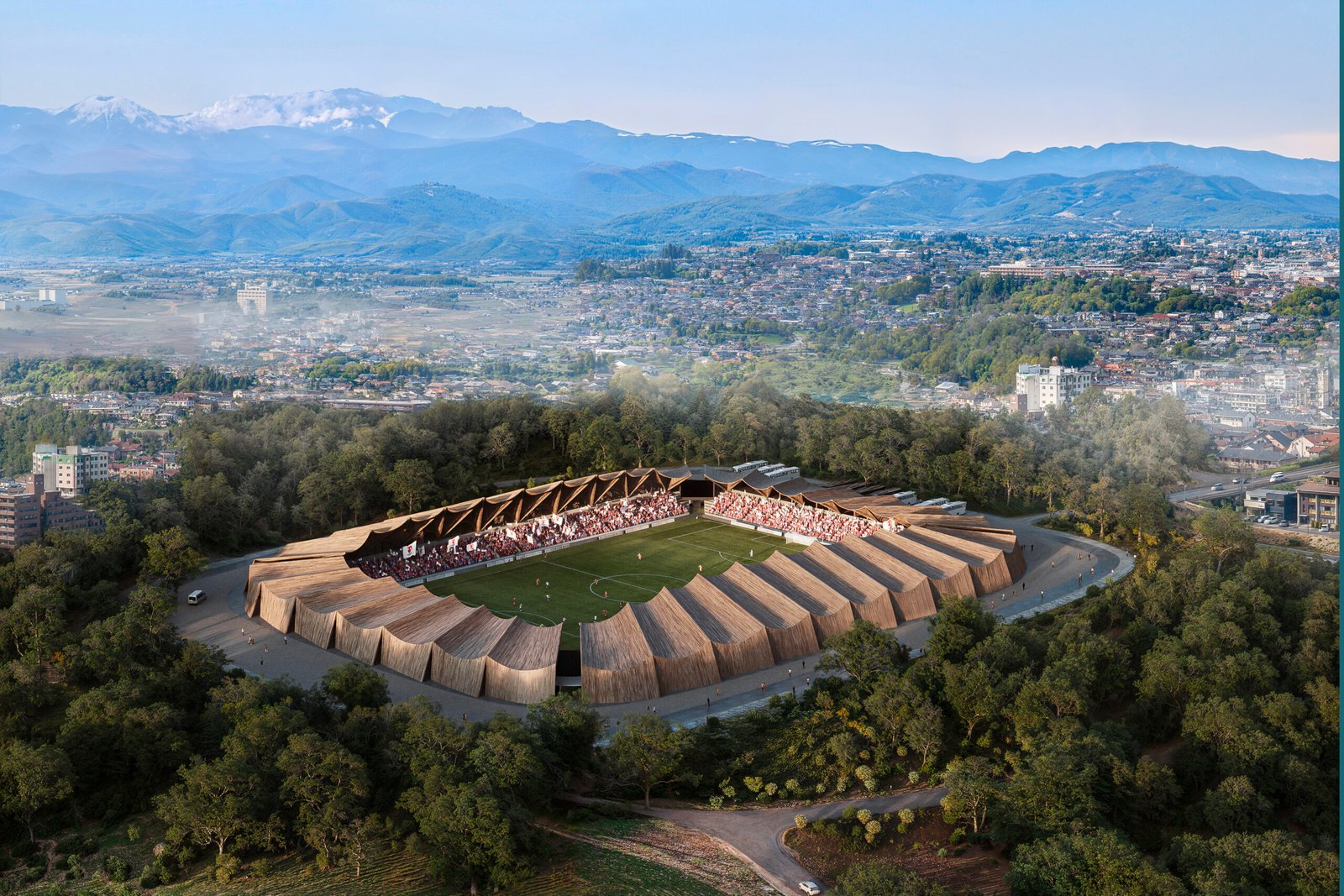
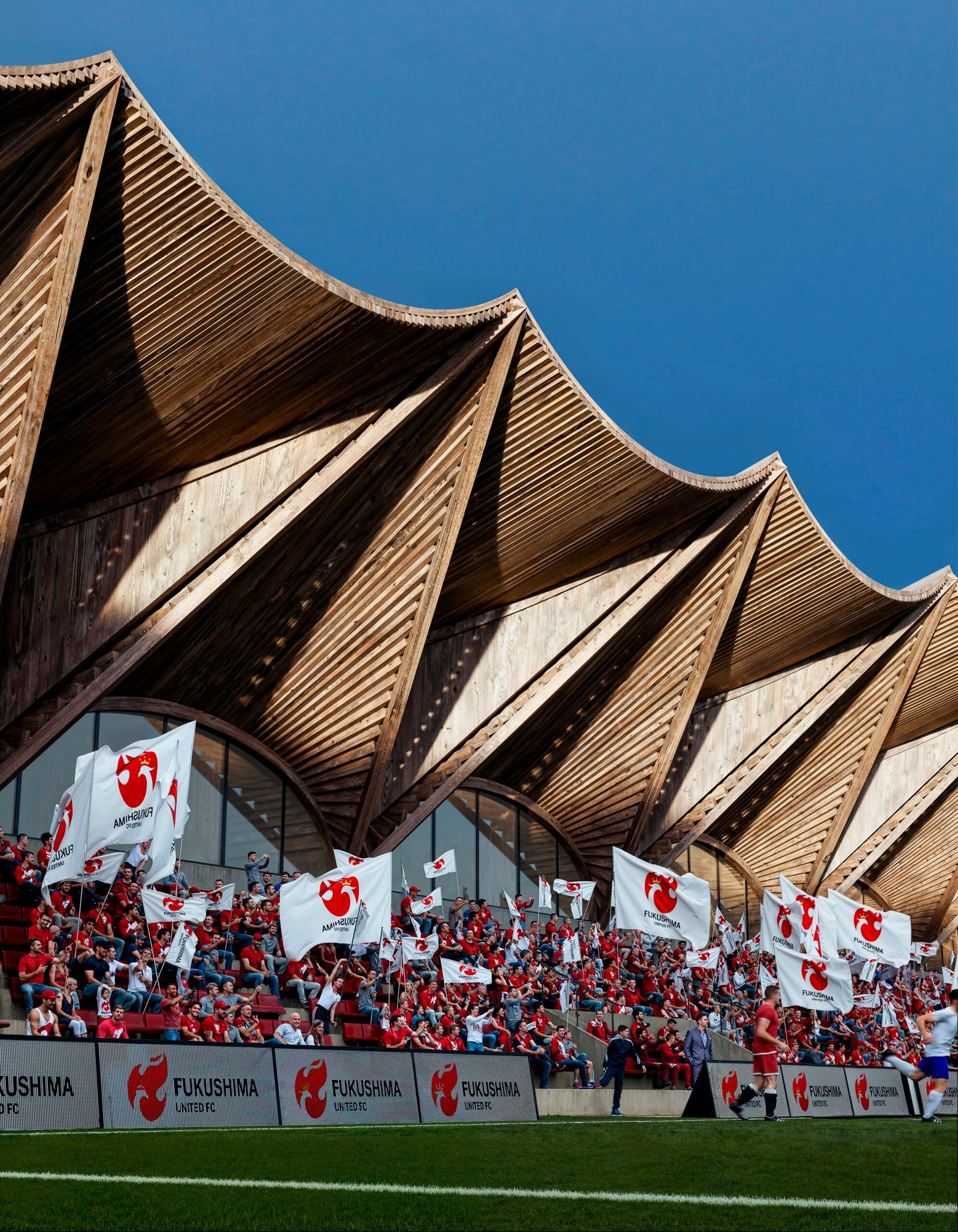
Fukushima United FC, operated by SportX, together with the architectural startup VUILD Inc., unveiled the design concept for their new home stadium in Fukushima Prefecture. The stadium is planned to be built with the active participation of local residents, serving as a symbol of recovery, and aspires to become a regenerative stadium that Fukushima – and the world – can take pride in.
A wooden stadium as a symbol of recovery
Founded before the 2011 Great East Japan Earthquake, Fukushima United FC has grown together with the region’s recovery. Looking ahead to the club’s further development, the team revealed a vision for their future home stadium. The new stadium embodies the spirit of the phoenix engraved in the club’s emblem – standing as a symbol of hope and rebirth. Born in Fukushima, a region deeply affected by the earthquake and nuclear accident, the project seeks to present a sustainable stadium model that the world can be proud of, sending a powerful message of resilience and renewal from this land to the future.
Built with Fukushima timber and citizen participation
The concept draws inspiration from Shikinen Sengu, the periodic rebuilding of shrines in Japan. Drawing on its spirit of renewal and transmission, this project establishes its own three cycles – resources, community, and craftsmanship. Guided by this framework, the stadium will use an all-timber structure built by laminating locally sourced wood from Fukushima. Each component will be designed for disassembly and reuse, supporting circular use of regional resources. The fabrication and assembly will invite club members and local residents to participate in a festive, community-driven process. Through reforestation initiatives and woodworking education, skills will be passed to the next generation, sustaining a continuous cycle of resources, culture, and technology.
Harnessing Fukushima’s basin climate for energy circulation
For energy systems, the design incorporates passive strategies that leverage Fukushima’s basin climate. The roof form blocks summer sun while shielding against winter winds. The varied façade geometry allows prevailing winds to be captured in summer and blocked in winter. Rainwater will be collected, filtered, and reused, while snow stored in winter will serve as natural cooling in summer. Through these renewable systems, the stadium aims to minimize energy consumption and achieve energy self-sufficiency by storing on-site generated renewable power. Ultimately, the project will strive to meet the Living Building Challenge , the world’s most rigorous environmental performance standard.
Design concept
When considering a 5,000-seat stadium, the initial focus was on the idea of ‘circulating a small cross-section’. In small-scale stadiums, it is common to concentrate most seating in the main stand for future expandability. However, such an approach often results in a megastructure, leading to higher costs. In this project, the overall form is generated by circulating a section equivalent to that of a two-storey house. This enables cost control, improves buildability, and allows for human-scale construction achievable through manual labor.
In terms of layout, the building is divided into four volumes of less than 3,000 square meters each, avoiding classification as a fireproof structure under code. The sections are limited to two storeys and a maximum height of 16m. The boundaries between the four volumes serve as entrances, combining circulation with architectural articulation. Ground-level spaces accommodate locker rooms, waiting rooms, restrooms, and concessions. On the second floor of the main stand, key functions such as VIP seating and broadcasting facilities are placed, while the back stand incorporates hotel facilities to enhance revenue potential.
To realize this plan, a span of approximately 6m was required. The project adopts an Hyperbolic Paraboloid Shells structure (HP Shells), formed by bundling small cross-section members. This approach enables both roof cantilevers in the short direction and large spans in the long direction. Additional trusses are placed above the shell, from which timber members are suspended in a catenary form to create the roof. By combining HP shells with catenary structures, the design achieves both rationality and symbolic expression. The resulting triangular roofscape evokes the traditional thatched-roof houses of Ōuchi-juku in Fukushima, harmonizing the stadium with regional identity.
The construction process itself is also designed to be distinctive. Structural members are planned to be transported and raised by local participants, assembling the shell and suspended roof in a festive manner inspired by mikoshi processions and ceremonial timber-raising rituals. In this way, construction becomes more than a technical operation – it becomes a celebratory act and a symbol of collective recovery.
Structural design
The semi-outdoor roof of the stadium is conceived using straight timber members arranged into HP shells and catenary surfaces, resolving complex geometries through a simple and rational system. Using straight members offers advantages in ease of fabrication and assembly, cost efficiency, sustainability through local timber use, and compatibility with both structural types.
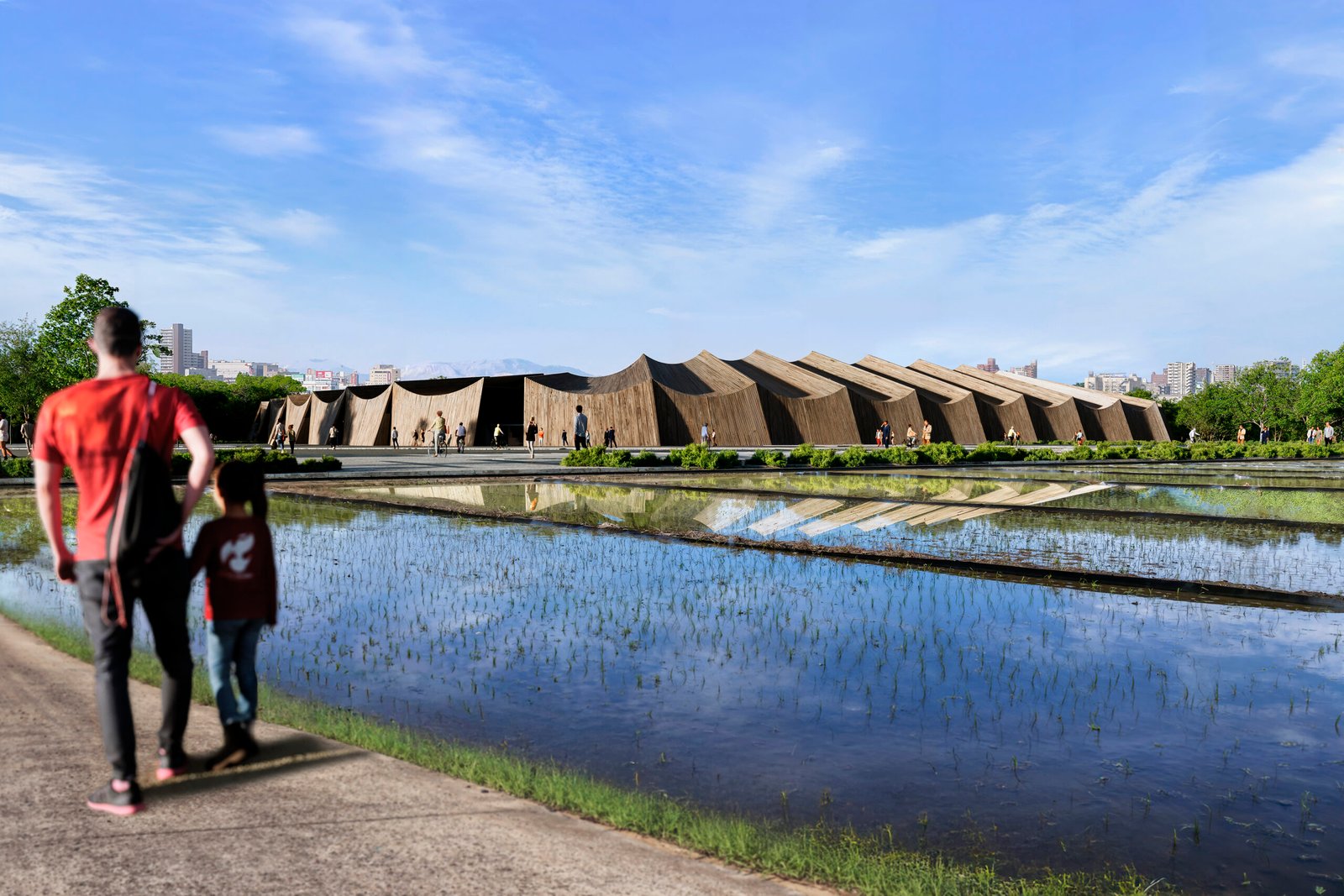
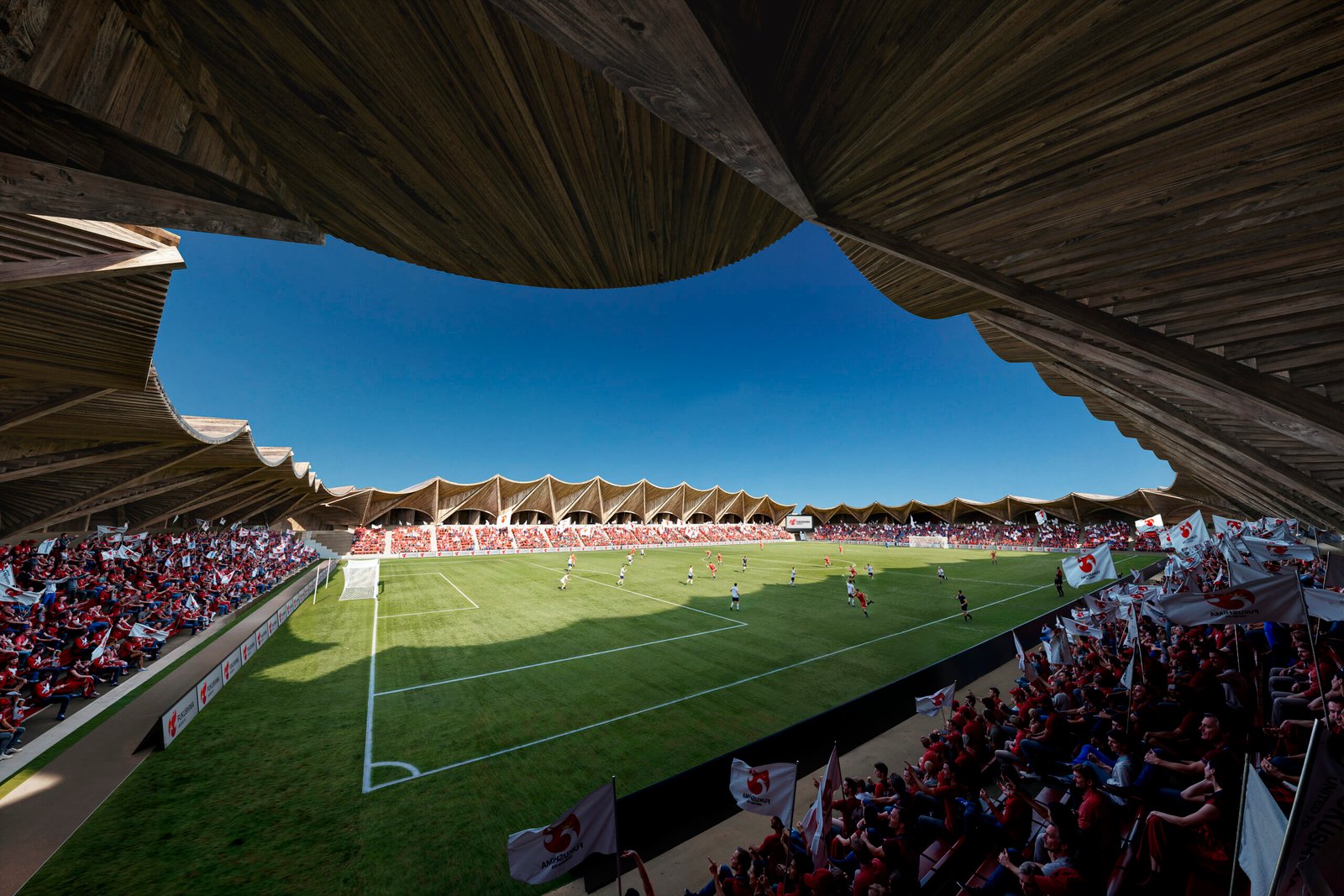
The HP shell is inherently rigid and can span large distances without intermediate supports. In this project, straight members are twisted incrementally to form the HP surface. The diagonals of the shell land on the ground, generating an arch effect that secures stiffness. The edges of the HP shell function both as load-bearing roof planes and as column-like linear supports, thus combining planar and linear structural roles.
Around the perimeter and along the diagonals, timber trusses are integrated to enhance surface stiffness, ensure structural safety, and provide guidance during assembly. Above the HP shell, straight timber elements are arrayed to form a catenary surface, fixed in place with screws piece by piece. Prestress is introduced during assembly, ensuring both geometric stability and structural performance. This creates a lightweight yet high-capacity system.
All timber used is sourced from Fukushima Prefecture. The shells are formed by joining sawn timber with structural screws to create Nail-Laminated Timber (NLT) units, which are fabricated off-site by local hands and assembled on site. This method promotes the use of regional resources and a participatory construction process. By merging structural rationality with community involvement, the stadium becomes an architecture shaped by both Fukushima’s forests and its people.
Environmental design
The project maximizes the site’s climate and natural conditions through passive design strategies, creating a sustainable and comfortable stadium. The roof is carefully shaped so that the south side remains short, allowing ample sunlight to reach the pitch and promote photosynthesis, thereby ensuring healthy turf growth. On the north side, the roof extends toward the field to block direct summer sunlight at high solar angles, securing comfort for spectators.
Rainwater falling on the roof is collected in storage tanks beneath the stands and reused for pitch irrigation and toilet flushing, reducing potable water consumption, environmental impact, and operating costs. The external walls function as wind catchers, channeling prevailing northwesterly winds into the interior and seating areas during summer and transitional seasons. This passive airflow reduces heat stress, minimizes reliance on mechanical ventilation and cooling, and, with additional ventilation slits beneath the stands, creates a continuous flow of air across the pitch that further supports turf growth.
In addition, the severe winter cold is harnessed to produce ice, which is stored in chambers beneath the stands. During the summer months, the stored ice is melted, and the resulting cool air is used for air-conditioning, reducing HVAC loads. Through this integrated approach, nature and architecture work in harmony, minimizing energy consumption while providing a sustainable and comfortable environment for spectators, athletes, and the turf alike.
Multi-objective optimization
The stadium’s form is treated as a set of quantifiable parameters, allowing for optioneering across multiple performance criteria. These include the thermal comfort of spectators measured by SET* (calculated from temperature, humidity, airflow, radiation, clothing, and metabolic rate), the contribution to carbon neutrality through the volume of structural timber used, the wind velocity across the pitch, and the environmental conditions required for healthy turf growth. By examining these factors simultaneously, the project enables a quantitative understanding of the interrelationship between form, structure, and environmental performance, with the goal of maximizing both the spatial quality of the stadium and its ecological responsiveness. Beyond structural rationality, the design aspires to create a sustainable architecture that fosters environmental adaptability, human connection, and the integration of local resources.
Such an integrated design methodology – addressing architecture, structure, environment, and construction simultaneously – is made possible through collaboration between VUILD, which operates seamlessly from digital design to digital fabrication (directly processing and assembling components from digital data), and Arup, the global engineering consultancy (headquartered in London, Tokyo office in Chiyoda). By merging their advanced digital expertise, the project seeks new models for truly regenerative architecture.
To realize this plan, a span of approximately 6m was required. The project adopts an Hyperbolic Paraboloid Shells structure (HP Shells), formed by bundling small cross-section members. This approach enables both roof cantilevers in the short direction and large spans in the long direction. Additional trusses are placed above the shell, from which timber members are suspended in a catenary form to create the roof. By combining HP shells with catenary structures, the design achieves both rationality and symbolic expression. The resulting triangular roofscape evokes the traditional thatched-roof houses of Ōuchi-juku in Fukushima, harmonizing the stadium with regional identity.
The construction process itself is also designed to be distinctive. Structural members are planned to be transported and raised by local participants, assembling the shell and suspended roof in a festive manner inspired by mikoshi processions and ceremonial timber-raising rituals. In this way, construction becomes more than a technical operation – it becomes a celebratory act and a symbol of collective recovery.
Structural design
The semi-outdoor roof of the stadium is conceived using straight timber members arranged into HP shells and catenary surfaces, resolving complex geometries through a simple and rational system. Using straight members offers advantages in ease of fabrication and assembly, cost efficiency, sustainability through local timber use, and compatibility with both structural types.
The HP shell is inherently rigid and can span large distances without intermediate supports. In this project, straight members are twisted incrementally to form the HP surface. The diagonals of the shell land on the ground, generating an arch effect that secures stiffness. The edges of the HP shell function both as load-bearing roof planes and as column-like linear supports, thus combining planar and linear structural roles.
Around the perimeter and along the diagonals, timber trusses are integrated to enhance surface stiffness, ensure structural safety, and provide guidance during assembly. Above the HP shell, straight timber elements are arrayed to form a catenary surface, fixed in place with screws piece by piece. Prestress is introduced during assembly, ensuring both geometric stability and structural performance. This creates a lightweight yet high-capacity system.
All timber used is sourced from Fukushima Prefecture. The shells are formed by joining sawn timber with structural screws to create Nail-Laminated Timber (NLT) units, which are fabricated off-site by local hands and assembled on site. This method promotes the use of regional resources and a participatory construction process. By merging structural rationality with community involvement, the stadium becomes an architecture shaped by both Fukushima’s forests and its people.
Environmental design
The project maximizes the site’s climate and natural conditions through passive design strategies, creating a sustainable and comfortable stadium. The roof is carefully shaped so that the south side remains short, allowing ample sunlight to reach the pitch and promote photosynthesis, thereby ensuring healthy turf growth. On the north side, the roof extends toward the field to block direct summer sunlight at high solar angles, securing comfort for spectators.
Rainwater falling on the roof is collected in storage tanks beneath the stands and reused for pitch irrigation and toilet flushing, reducing potable water consumption, environmental impact, and operating costs. The external walls function as wind catchers, channeling prevailing northwesterly winds into the interior and seating areas during summer and transitional seasons. This passive airflow reduces heat stress, minimizes reliance on mechanical ventilation and cooling, and, with additional ventilation slits beneath the stands, creates a continuous flow of air across the pitch that further supports turf growth.
In addition, the severe winter cold is harnessed to produce ice, which is stored in chambers beneath the stands. During the summer months, the stored ice is melted, and the resulting cool air is used for air-conditioning, reducing HVAC loads. Through this integrated approach, nature and architecture work in harmony, minimizing energy consumption while providing a sustainable and comfortable environment for spectators, athletes, and the turf alike.
Multi-objective optimization
The stadium’s form is treated as a set of quantifiable parameters, allowing for optioneering across multiple performance criteria. These include the thermal comfort of spectators measured by SET* (calculated from temperature, humidity, airflow, radiation, clothing, and metabolic rate), the contribution to carbon neutrality through the volume of structural timber used, the wind velocity across the pitch, and the environmental conditions required for healthy turf growth. By examining these factors simultaneously, the project enables a quantitative understanding of the interrelationship between form, structure, and environmental performance, with the goal of maximizing both the spatial quality of the stadium and its ecological responsiveness. Beyond structural rationality, the design aspires to create a sustainable architecture that fosters environmental adaptability, human connection, and the integration of local resources.
Such an integrated design methodology – addressing architecture, structure, environment, and construction simultaneously – is made possible through collaboration between VUILD, which operates seamlessly from digital design to digital fabrication (directly processing and assembling components from digital data), and Arup, the global engineering consultancy (headquartered in London, Tokyo office in Chiyoda). By merging their advanced digital expertise, the project seeks new models for truly regenerative architecture.